Introduction
Well we were promised that when the Focus Edition came out, they were only subtracting information from the GMAT rather than adding it.
And then we find Completing the Square questions on the test.
This is a quadratics topic that was never in the GMAT curriculum before FE, so you do the math on who’s up to speed with the content of the exam.
This lesson is going to assume that you know the basic approach to breaking apart a quadratic and work from there.
Starting Out – Perfect Squares
The important thing to remember with Completing the Square GMAT questions in quadratics is that it relies on perfect squares. Of course it makes sense that if we are to complete a square, we must have a square in the first place.
So let’s go back to basic identities here:


Both of these are perfect squares. Understanding the expanded form ( ) will be vital to understanding where we go from here.
The Purpose of Completing the Square
Completing the Square is used for quadratics that can’t be broken easily by guessing and checking. It’s a sort of halfway point between using the guess-and-check factorizing method that will work for most cases on the GMAT and actually plugging in to the Quadratic Formula.
(I would normally say never to memorize the Quadratic Formula, but given how the topics seem to be drifting on the GMAT, it’s probably worth memorizing.)
That is, Completing the Square becomes relevant in situations where the middle term–the 2ab –cannot be directly associated with the b2. This is where things get weird and speculative.
This will be better done with an example. Let’s start with what we know to be a perfect square:

So far, so good. Now if we alter this slightly so that the last term isn’t b2, then we encounter a situation where Completing the Square becomes useful. That would look something like this:

What we do at this point is to assume the middle term 2ab is actually the middle term of a perfect square, which makes our whole statement “a perfect square plus something.”
That is,  . Note how this is expressed as “a square plus something.”
The whole point of Completing the Square is basically to figure out what perfect square can be made from what’s already there–plus or minus something at the end.
Let’s try a couple more for the sake of argument. Always focus on the middle term!

This one is a little bit trickier, but the thing to do is split the 3 into  :
:

Now of course GMAT won’t make it textbook-easy, because that would be boring (and AI could explain it easily).
Making it More “GMAT” — Completing the Square GMAT
In order to be more annoying, GMAT has a tendency to write its quadratics not in the form ax2 +bx+c but rather ax + bx+c.
I’ll convert the  above into something more along those lines:

So you can see that it solves in the same way, given that the relationship between x and x is similar to the relationship between x and x2. That is, x here is x raised to the second power, just as  is simply
  raised to the second power.
An Example
Now of course it would be pointless for us to work without a firm example from Official materials here.
Let’s look at a particular Completing the Square question:
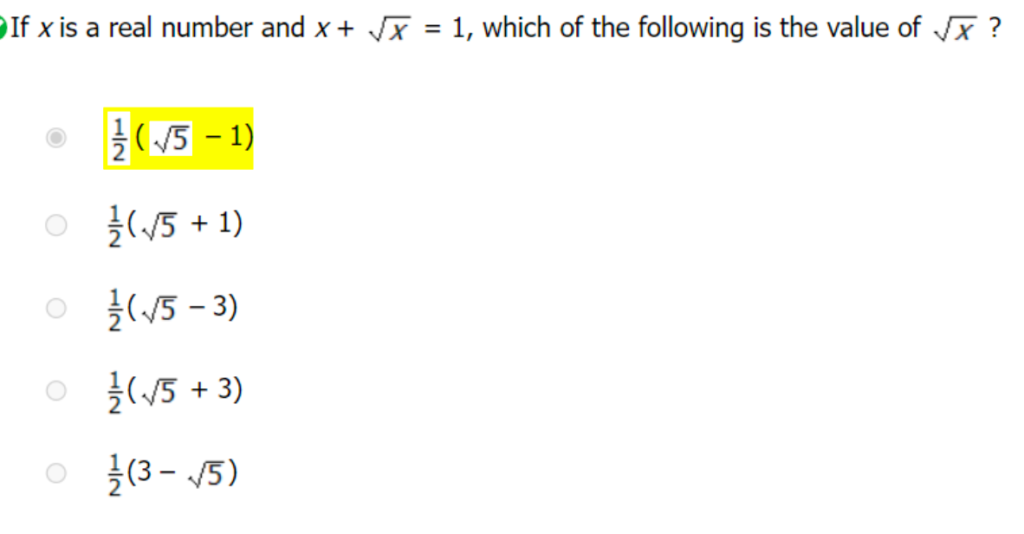
Now clearly we have the answer marked here, but that’s beside the point. We still have to arrive at the answer somehow.
So let’s start at the beginning. First, we want this to be a quadratic in the form  .
.
That is, we’ll make it: 
Now consider what the perfect square would be where the middle term becomes x. That is…

(See how that works? If not, expand out the right side and see how it matches the left side. Remember, the middle terms are the same and add to each other.)
So if we put this back into , we find this:

On a practical note, I find the double bracket on the left side a useful thing to remember. We are introducing the 14 so it needs to be subtracted off as well. The double bracket helps to remember to do that. Always be aware of what you’re imposing on the equation so that you know what you have to remove.
So… simplifying from  , we find:


Take the square root of both sides:


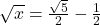

And always keep your eye on the ball. Remember we’re looking for the value of  , so this is the answer: (A) – as if it wasn’t already highlighted in yellow.
Video Explanation
Oh by the way there’s a video explanation of this whole question as well. You’ll find it at this link.
The video also includes a way to do this without Completing the Square, but I assure you that the Completing version is easier and less time consuming.
Conclusion
So those crazy cave-dwellers in Iowa writing the GMAT decided to throw us for a loop with this Completing the Square silliness after we were promised “no new topics,” but what can we do? We’re stuck with it now.
Luckily it just means remembering back to when you were 15 and revising one relatively simple concept. The hardest part is probably conceptually recognizing  as a quadratic statement. Once that’s out of the way, you’re good.
Interested in more GMAT materials? Check out our free 8-video 705+ Arithmetic Shortcuts guide here: